Esfahan Market Delight

The Grand Bazaar of Isfahan

Esfahan is not only one of the top travel destinations of Iran but also the place to get something to take home.  The US has many restrictions on how much it’s citizens can spend in Iran. This restriction along with the obstacle of having enough cash to float you the whole visit restricts spending and raises the question “What do I buy and where”?  It’s a conundrum but I’m going to make it easy.
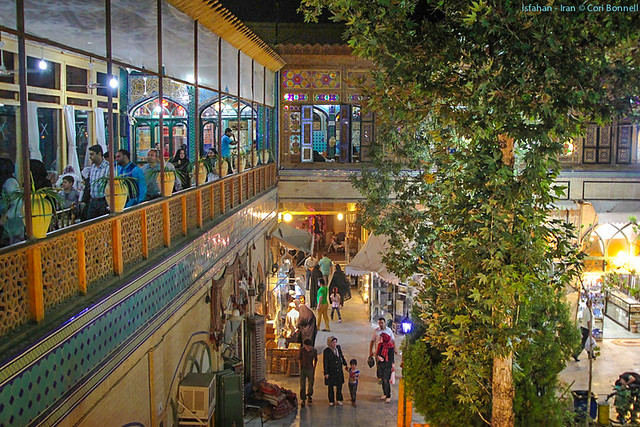
Isfahan Traditional Restaurant - Naqsh-e Jahan Square
Naqsh-e Jahan Square Shopping area and the Isfahan Traditional Restaurant

First, Esfahan is located on the central tourist route which goes from Shiraz in the south to Tehran in the north.  It’s not to say that other cities and towns along the way won’t have unique items available to buy such as carpets in Kashan or Qom or enamel wares found in Shiraz shops. Esfahan is home to masters of  miniature painting found on camel bone and has some nice carpet shops.

Miniatures on Camel Bone or parchment:

Chehel Sotoon Palace
Chehel Sotoon Palace where Reza Abbasi is on display

Esfahan was one of the many cities in the vast Persian Empire who developed a Persian standard to the style and composition of miniature paintings.  The city has been a center for Persian traditional crafts for centuries.  The paintings were indirectly  by Chinese and Indian art but have their own unique characteristics including bright colors, idealistic settings and later, scenes of ordinary life.  Works beauty and detail continued to blossom throughout the Safavid period.  Shah Abbas the Great wanted to see Persian artists take the miniature art to the next level and give the craft a distinct Persian look to it.

The miniature reminds me of whales tooth scrimshaw that was done by sailors while they waited for Moby Dick to come along.   In ancient Persia, small finely detailed paintings depicting Polo matches, bird hunting and a romantic meetings were created on the surface of camel bone and parchment.  Miniature style progressed and the pictures began to intentionally go beyond the rectangle borders and included poems. Artists were commissioned by royalty and many began studying the craft as demand increased throughout the Ṣafavid Period.  Most of the pieces seen in galleries and museums around the world today are ones done by or similar to the style of Reza Abbasi who worked in the Late Safavid period under Shah Abbas I.  Some are currently on display in The Metropolitan Museum – New York.

There’s plenty of miniatures on display and for visitors to buy and take home.  Like most of Iran, there’s little pressure to buy, so take time and check out the many studios located in the bazaar corridors of the square.  It doesn’t cost anything to look and many shopkeepers are keen on educating their customers on what they have to sell. Esfahan is the best place to even just look.

Carpets

Carpet Museum of Iran

Iran is most famous for its carpets which are filled with geometric shapes, flowers, tendrils and shapes that almost look like animals.  The carpets are on display in hundreds of shops around Esfahan.  The only thing potential buyers need is time, patience and some kind of idea what they are looking for.  Some say it’s not the buyer choosing the carpet but the carpet chooses you.  This is if you have the funds of course.  If not,  there’s always the token small patch of carpet that are used for seat covers that will set you back a quarter million Rial, or 25K tomans or $25 USD.  I know it’s confusing but if you go better get your currencies straight because some prices are based on Rial and some on the old Toman.


Destination Esfahan

It has been given the historical title of being “half of world”  for a reason.  To see it was to see half the world.  To miss Esfahan would be missing a big part of modern Iran.

Naqsh-e Jahan Square
Sunset in Naqsh-e Jahan Square

It was named the capital of Persian twice under two different ruling powers and is a place that has both vastly prospered and suffered at the hand of Arab and Mongol conquers through the centuries.  It divided by the great Zayanderood River and historically was a central stop along the ancient Silk road. Its trade status ended when the shipping giants like those found in the Netherlands took over with their faster transport and water routes.

This city dates back to the hunter gatherer Paleolithic Era still remains Iran’s cultural and agricultural center. It’s been sacked a number of times and rebuilt.  Most of what is seen today was built during the Safavid times. Shah Abbas I united Persia and made Esfahan its capital once again during this period and built an elegant city that was all the envy of the east as well as the west.

Sheikh Lotfollah Mosque
Morning at Sheikh Lotfollah Mosque

Many of its neighborhoods found here in a way shows how diverse this city was due to its importance in trade along the Silk Road. There is a large Armenian Quarter called New Julfa in Esfahan. Here there are many churches still open for Christian worshipers including the large Vank cathedral. Many remain but the numbers are dwindling and many are leaving for cities outside of Iran including Marseilles and Los Angeles.
Vank Cathedral
Courtyard the Vank Cathedral in the Julfa Armenian Quarter
Shah Mosque
Imam Mosque in Naghsh-i Jahan Square

Esfahan is amazing at night so hang out as much and as long as you can during your visit;  No going to bed early:

Late day arrivals still have plenty to see after the sunsets.  Esfahan lights up like a stage at night. The bridges of the Zayanderood River offer coffee houses, evening picnic areas and entertainment.  It is common to hear local men singing beneath the arches of the Khaju bridge.  The Iman square, once a polo field, is now a place where kids on bikes raise alongside the horse-drawn carriages. The posts found on either side of the square were once goal markers. Photographers get some of their best chances to capture Esfahan under the stars and in all of its illuminating splendor well into the evening.

Khaju Bridge
Beautiful evening at the Khaju Bridge
Sheikh Lotfollah Mosque
Sheikh Lotfollah Mosque in Naghsh-i Jahan Square
Naqsh-e Jahan Square
Naqsh-e Jahan Square late at night

Esfahan is a city that is full of things to see and one which needs at least three full days to a few months if you really want to experience it.  Getting a visa for such a long stay is another question.  With that said,  three full days is perfect.  I would almost say stay less in Tehran and spend more time here since it’s a better walking city and much less polluted. Keep a fair amount of your shopping budget available for here. There’s a great deal of things to choose from. There’s plenty of postcards and are it’s the place to splurge on a carpet or miniature painting. By the way, stamps to the US and elsewhere are expensive, so when the shop keeper is saying you need to put over $1 USD on a postcard believe him/her – it’s expensive. Big surprise, right?

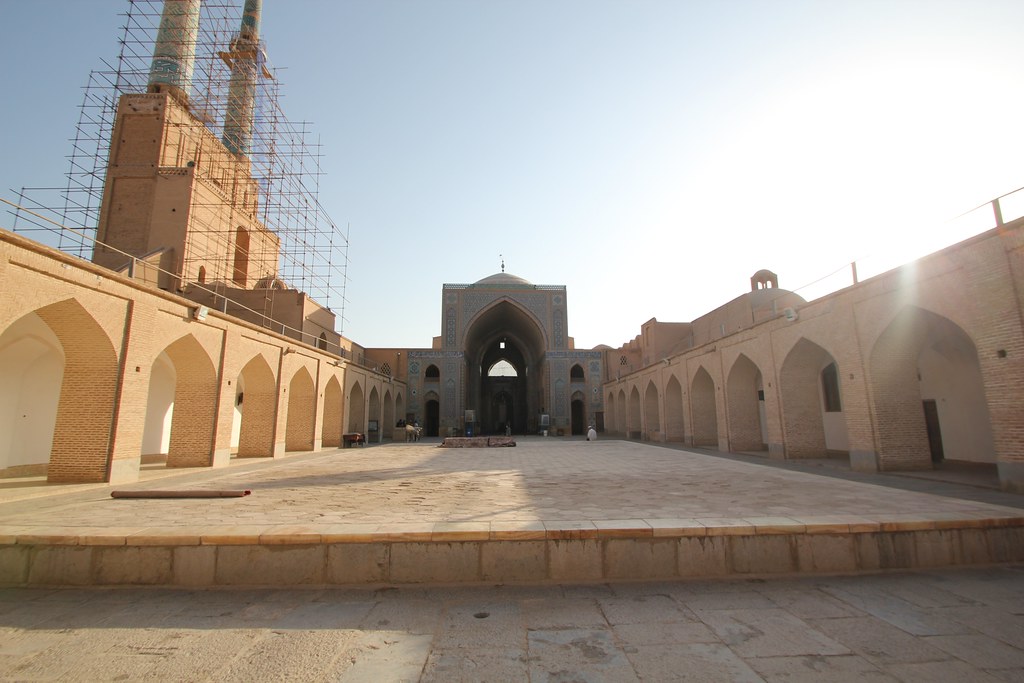
A Walk Around the Jameh Mosque of Na’in

A visit to the oldest inhabited city – Yazd, and now we go and visit the to the oldest mosque in Iran – the Jameh (Friday) Mosque of nearby Nain

Na'in's Jame Mosque

The city is not only famous for its fine silk carpets but for its Jameh Mosque.  The outside is very simple and not as colorful as many I have seen so far.   It’s design is known as the Khorasani style and was  originally constructed in the 8th century AD. It’s basement is thought to have once been a fire temple so it was first used by members of the Zoroastrian faith.  The mosque is without a three-sided Iwan and does not have the typical tiled dome or grand entrance to other mosques in the area.

Na'in's Jame Mosque

This afternoon we had the place to ourselves.  The alabaster stones found in the ceiling helps illuminate the area during the day when worshippers gather to pray during the hot summer and cold winter days.  The details of the columns and the carvings on the wooden Minbar are a wonder to see in person.

Na'in's Jame Mosque
Na’in’s Jame Mosque Minbar and prayer area

Like many mosques, the Jameh Mosque transformed to what it is today over the centuries with each conqueror making their additions to the structure.  The elaborate brick work seen on the columns and much of the interior  inside were characteristic of the Seljuk period which was around the 11th century. The unusual octagon shaped minaret and wooden minbar was also added to 700 years ago.

Na’in is a natural compliment to seeing the Jameh Mosque found in Esfahan. I recommend seeing it first if you can. It’s makes a good rest stop on the trip between Esfahan and Yazd.

Na'in's Jame Mosque
Mihrab and the wooden Minbar at the Jameh Mosque in Na’in
Na'in's Jame Mosque
Mihrab in the Jameh Mosque
Na'in's Jame Mosque
Grave marker (left) inside of Jameh Mosque in Na’in

The controversial graffiti I referred to at the beginning:

Na'in's Jame Mosque
Grand Ayatollah Ali Khamenei and the Grand Ayatollah Ruhollah Khomeini
Grafetti inside the Na'in's Jame Mosque
Grafitti inside the Na’in’s Jame Mosque
Old section of Na'in
Old alleyway of Na’in

A typical day for visitors on a guided tour of Iran

What does a typical day on a guided tour in Iran look like?

Curious on what actually goes down when you are an American on a mandatory guided tour in Iran?  It’s not as bad as it sounds and there’s no choice in the matter since we are Americans. My husband and  I, like many travelers,  usually prefer to go at my own speed when we take a trip.   We get typically get by with help from good pre-trip research, a guidebook with a good map, on site pointers from other travelers we meet along the way and the occasional internet search at the local internet cafe/hostel.

Many who are considering a trip to Iran wonder simply what a day is like when you need to be escorted around by a local guide.  I found plenty of videos; pictures; blog posts about traveling in Iran but little information about how a typical day went down.   I understand it may not be very exciting material but I hope it gives others a little more insight on how things roll along during a typical day.  I travel independently so tours aren’t usually a part of my travels except for the occasional organized day trip to a protected area which requires a guide.

My typical day:

7am: Get up  and wait for our guide to do the same.  The first few days the time was more like 3am but it worked its way eventually to 7am. I like early starts even if it means chilling out for a couple of hours waiting for our fixer.

9am:  Meet our sleepy-eyed guide for breakfast which hopefully includes eggs, fresh bread, cheese, butter, jam (hopefully not of the carrot variety) and of course cups and cups of tea.  I’m excited when things like hot soup, real coffee and pastries are there as well.  This happened a couple of times.

Shiraz Niayesh Traditional Hotel
Dining area of the Niayesh Hotel in Shiraz early morning…it’s 7am..where is everyone?

10am ish:  Or somewhere around that time…Check out the sites until it gets really hot which usually coincides with lunch hour at high noon.

12pm – 1pm:  Many things that require an entrance fee close at this time anyways.  It’s a good time to have lunch when everyone else does.  Lunch usually is the biggest meal of the day and the choices are very much like dinner.   The vegetarian menu typically has been limited to rice, bread, yogurt/Doogh and the usual plate of  Kookoo Zabzi –  sometimes the cook has other choices but usually it means meat dishes where the meat is literally picked out of the plate.  I decided I had enough Kookoo Zabzi and alternated with kebab.

12pm-late afternoon: Our guide goes to the gym and lets us have some time to ourselves.  This is when I have a few minutes out of the sun and let my hijab down.  It was hot that day but no complaints.  The hijab kept my head safe from the suns rays.

Persepolis
Mid day in Persepolis

3-4pm:  We take off again to see sites in the best light and before evening prayer time.

Shah Cheragh Mosque
Evening prayer time at the Shah Cheragh Mosque in Shiraz

Around Sundown:  We have dinner and check out what goes on after the sun sets.  This is when I hope to find something sweet like Saffron Ice cream and get some good night shots.  The evenings are when most cities typically come alive.

Our view of the Sweeping Mosque or Bibi Dokhtaran Mausoleum near by
Our view of the Sweeping Mosque or Bibi Dokhtaran Mausoleum near by in Shiraz
Shiraz Market near the Nasir al-Mulk Mosque
No pistachio Ice cream but plenty of other sweets to choose from in Shiraz

Best of Yazd: From getting lost in the quiet alleyways to enjoying the view from the rooftops

Yazd is oldest city in the world and to get to know it a visitor needs to see it from all angles

Alleyway in Yazd

The adobe alleyways in the old city  keep the dwellings protected from the sun, large vehicles out and water fresh and cool below.   My visit started on a thursday after noon and ended a couple of days afterwards.  It is considered the weekend here and it was quiet for the most part.   The  doorway found along the alleyways are modest entrances to the beautiful homes which lie behind. They traditionally  contain a courtyard filled with plants and a pool of water and have rooms circulating around it.

Doorway in Yazd
Doorway in Old Yazd

Plenty was open and available to see since the weekends are times when families spend time together and also visit tourist sites. We arrived in the late afternoon on thursday. We got to see a couple of sites before getting a bite to eat at the Silk Road Hotel. The food was pretty good there. The standard menu of kebab, Kookoo Zabzi, Rice, salad and Doogh. Fridays get pretty quiet here. Most activity ceases until after the evening prayer. At least we can find a place to get a cold drink as we explore the empty bazaar.

Bazaar on a Friday in Yazd

We left Sunday and found out that this was a good choice since most shops are closed in this conservative town. This includes the famous Haj Khalife Ali Rahbar Confectionary Shop near the Amir Chakhmaq square. I luckily got to it on Saturday and bought my 1/2 kilo of Qottab – it’s sort of like Mexican Wedding cookies with cardamom.

Pastries at Haj Khalifeh Rahbar's shop
Pastries at Haj Khalifeh Rahbar’s shop

Our days were filled with visiting mosques in town; visiting Zoroastrian landmarks; taking day trips to the UNESCO sites of Chak-Chak and Kharanaq; and eating and sleeping in between. Yazd is definitely on the list of places to come back to when revisiting again in the future.

Masjed-i Jamé mosque
Sunrise in front of the Masjed-i Jamé mosque
Masjed-i Jamé mosque
Courtyard of the Masjed-i Jamé mosque
Masjed-i Jamé mosque
Inside the Masjed-i Jamé mosque
Masjed-i Jamé mosque
Iwan of the Masjed-i Jamé mosque
View of Jameh Mosque from Orient Hotel
View of Jameh Mosque from Orient Hotel in Yazd

Yazd – the City of Badgirs

I usually like to find attractions along the way which are overlooked and ultimately not overcrowded. My interests are more than checking off a list which usually means seeing what many don’t stop and see. I found many things in Yazd which may seem to be boring because of their name but ended up being quite interesting. Here’s my top things to see in Yazd list:

Yazd Heidarzadeh Coin Anthropology Museum:

It’s a museum that isn’t listed on most group tours going to Yazd which says to most “Don’t Go” but to me it goes on my “Must Do” list.

Yazd - Coin and Anthropology Museum

Sounds geeky right? It’s really in name alone. This museum is home to a large collection of coins which date back to the beginning of the first century.  A jewelry shop assistant and part time teacher named Mr. Hussein Heidarzadeh collected 5,000 pieces of different items including coins, banknotes, scissors, lantern, rosary, seal, scale, knife, samovar, silver ornaments, etc over his lifetime and donated most of them to the Cultural Heritage Organization here in Yazd. The coins and bills are not the only attraction here.  The interior of the building has been well attended to and is much more attractive then the water museum.  This could partially be because they get less traffic then the Water Museum.

It was late in the afternoon when we set out to find the Museum located in the old quarter of Yazd. The LP guide to Iran has the museum listed as a part of there walking tour of Yazd.  It was one of the few things open at 2:30pm on a Saturday afternoon. We followed the LP map and discovered a helpful english sign once we got past the closed tourist office. It’s easy to get lost in the labyrinth of covered alleyways of the old city but we finely made it to the museum. A young man and another friendly armed gentleman dressed in military fatigues answered the door when we knocked. It’s good to know we and the coins are safe.  It was just us, the coins and our minders.  How wonderful – we had the place to ourselves.

Yazd Coin and Anthropology Museum
Display accidentally taken inside the Museum

The Coin Museum located inside in a similar building which includes a well-kept central courtyard minus the crowds. The only draw back is that you can’t take pictures. I managed to get some because I accidentally hit my camera and wellah..I got a couple of shots. No harm done.


Yazd Water Museum:

Yazd Water Museum

I happened to visit in mid-day along with a large group of rather loud Castalian retired and hearing impaired visitors. Let’s say I was a bit put off by the crowd inside the narrow chambers. It was hard to hear what Mahmoud had to share with us while the group passed us by and spoke amongst themselves. At least the museum had a few visual aids to help explain the museum and the building it occupied.

Yazd Water Museum

Yazd Water Museum

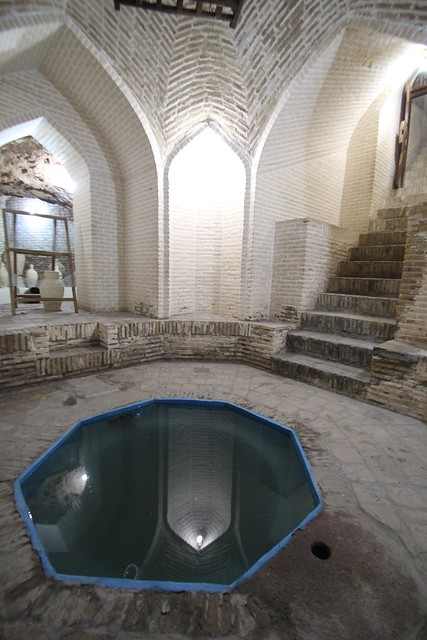
Many go to the Water Museum so they can check out how wealthier Yazd residents lived 100 years ago. The former home is in excellent condition and it’s great to see how the cooling system worked in the home, but there was one big drawback. It gets crowded. I would suggest to skip it but try to find an off-peak time to visit. Possibly when it first opens and large groups are still having breakfasts or late in the day when they are on the bus and rushing on to their next destination.  It’s located just across from the Amir Chaqmagh Complex and Hajj Khalifeh Rahbar Confections Shop.

Yazd: Windcatchers of the Desert Oasis

The top two things that come to mind when I think of my stay in Yazd are Windcatchers and its ancient Qanat water systems. Further confirming that I am a travel geek.

Amir Chaqmagh Complex (edited)
Amir Chaqmagh Complex

Just off of the Ancient Silk Road Highway

It survived Mongol invasion and its famous visitors include explorer Marco Polo in the 13th century and later in the 19th century British writer/traveler Robert Byron.  Byron wondered why others hadn’t noticed its beautiful architecture and asked the question, “Do people travel blind?”  Seems strange that one could visit Yazd without noticing its unique Windcatcher filled cityscape.  But,  it’s something I have asked myself more than once.  Marco Polo probably would have begged to differ since he found Yazd to be “a very fine and splendid city and a centre of commerce” when he traveled through it earlier in the 13th century.

Yazd Water Museum
The water that cools below the windcatcher above.

It’s possible that most were merely distracted by the hustle and bustle of the streets and just safely going about their business.  There are many things to contend with when walking the streets of Yazd.  The locals going to and coming from daily prayer, car and pedestrian traffic, lack of safe crossways, potentially hazardous centuries old water channels, and narrow sidewalks – just to name a few.  I imagine Yazd was just as bustling centuries ago as it is today.   It also as become a stop-off for modern-day explorers who participate in the Mongol Rally in the dead of summer.

Amir Chaqmagh Complex (edited)
Yazd – Amir Chaqmagh Complex

Windcatchers and water

The first thing that stuck me as a visitor in Yazd was the field of windcatchers which rise out of almost every structure in the city.  There are hundreds of them to be seen here. Many are not in use today but are reminders of Yazd’s industrious past.  They along with the qanat helped keep the city’s residents cool during the summer months when temperatures can get above  100 F.

Schoolyard in Yazd
Windcatchers in the Schoolyard in Yazd

Yazd is thought to be the oldest inhabited cities of Iran thanks to the qanat water system made during the Sassanian Period (224-651 AD).  The qanat along with the windcatcher systems keep the lower levels of many buildings and homes cool. This gives residents comfortable rooms to escape to during the steamy summer months and provides a safe place to store food within their home.

Doorway in Yazd
Doorway in the older section of Yazd

These water systems made centuries ago is the main reason this city still remains as it does today.  Water is scarce in this area found in the heart of the persian desert.  The climate is contradicting in the fact it is so dry but it’s full of pomegranate and date trees and fresh water streams still flow from the mountains.  The locals take pride that they and their ancestors have managed to have a water supply without the help machines and modern technology.

Today, Yazd is just as popular stop for travelers on the Silk Road as it was centuries ago. It remains the center of the Zoroastrian faith in Iran even though the numbers have dwindled. They are allowed to continue to worship as they please since Zoroastrians are ironically considered a religious minority even though they are the oldest known organized faith in the world.  The basic three tenets followed by Zoroastrians are: Good Thoughts; Good Words and Good Deeds.  Very good tenets to live by.

Kharanaq: Please don’t shake the Minerat

Ruined city of Kharanaq

Ancient Kharanaq is like a scene out of an old western with tumbleweed and the only signs of life are  some lonely donkeys and feral kitties.  The townspeople have moved into new housing just meters away.

Kharanaq
Kharanaq

The town itself is filled with winding covered passageways with rooms branching off of them. It’s easy to lose your sense of direction while venturing around.  The maze of passages deters thieves since it is difficult to make a quick getaway here.  I imagine that it also helps with keeping spaces inside warm in the winter since there isn’t a direct cross breeze to push warm air out of the interior space.

Ruined city of Kharanaq
Inside the labyrinth of passageways of Kharanaq
Shaking Mineret of Kharanaq
Roof of Kharanaq and it’s shaking minerat

The buildings themselves are basically made of mud and straw and are in a bad state.  Some renovations are going on now but I imagine that there is little funding and the process is slow.  Visitors are allowed to roam freely about the place.   Some visitors have actually fallen through the ceilings since they are naturally unaware of how fragile this place is.   The central minerat used to be open to visitors but it’s been damaged due to visitors carelessness.  This minerat is not flexible and isn’t meant to be shaken.  It’s just as fragile as the rest of the place so resist the temptation while visiting.

Ruined city of Kharanaq
View from the roof of Kharanaq
Ruined city of Kharanaq
Mosque in renovation inside Kharanaq
Ruined city of Kharanaq
Graffiti inside the Mosque – Kharanaq
Ruined city of Kharanaq
View of the hillsides next to Kharanaq

First stop in Yazd: Dolat Abad Windcatcher

It was a friday so things were pretty quiet in Yazd when we arrived.  The fire temple is a popular spot for families to visit on the weekend and it was busy but the stores were closed and only a few doors were open for visitors.  The Dolat Abad Windcatcher complex was one of those open doors.

Dolatabad house
Dolatabad house – Yazd

Yazd is famous for its many windcatchers. The malqaf or tall tower has an opening at the top which faces the prevailing winds. The tower catches the wind where it is cooled by flowing over an underground water source called the Qanat. The combination of the water and cooler walls located in the lower parts of the building cools the air and provides natural air conditioning.  It seems like a pretty green technology right?  I wonder why we don’t see more structures like this in use today.

Dolatabad House Windcatcher
The tallest windcatcher in Iran – 34 meters in height

The tallest wind catcher standing in Iran is the one here in the Dolatabad Garden in Yazd.  It’s 34 meters in height.  The building was the residence of Mohammad Taghi Khan in the Zand era.  The interior contains a pool which is under the windcatcher. The water seems to connect to the long rectangular pool that is outside and in front of the windcatcher.  The outdoor pool is surrounded by fruit trees, flowering plants and of course several traditional cypress trees.

Dolatabad house
Gardens of the Dolat abad House
Dolatabad house
Exterior wall and gardens of the Dolat abad house in Yazd

The building is very attractive and contains beautifully designed ceiling plaster work and colorful glass pained windows. It’s a great site to end the day and begin the days we will have in Yazd and the surrounding area. Time to finally check out our hotel and have a late lunch and tea.

Dolatabad house
Inside the windcatcher at the Dolat abad House – Yazd
Dolat Abad windcatcher area
Ceiling and surrounding plaster work of the windcatcher
Dolatabad house
Beautiful windows of the Dolat abad House – Yazd