General information for Central Asian visas in Tokyo

Keep the following tips in mind when getting visas here:

  • Plan, Plan, Plan. Specifically the order that you will be traveling to these countries, the number of entries desired, etc. Central Asian visas are date specific (i.e. 1-Sept-2012 to 31-Oct-2012 for 1 entry with a maximum time in country of 30 days).
  • Visas for these consulates normally take a week to process (up to two in the case of Uzbekistan), which would mean a month or so for all four. However, you can call ahead and explain that you’re getting all four and kindly ask if you can leave a copy of your passport instead of the original with the embassy. This way you can apply for all of them in parallel, cutting it down to a week. The consulates of Uzbekistan, Kyrgyzstan, and Tajikistan were happy to do this for us, but Kazakstan said they would have to keep our original passports.
  • If you apply in parallel you should do it in the following order: Kyrgyzstan and Uzbekistan (which are a few blocks from each other in Nakameguro) and Tajikistan and Kazakstan (which are a few blocks from each other in Roppongi).
  • Pick them up in the opposite order. When we picked up our passport from the Kazak embassy, we dropped off our passports at the Tajik embassy. The next day we went back and picked them up from there and then went to the Kyrgyz and Uzbek embassies (who put the visas in on the spot).
  • When speaking to the the person from the embassy and using English, please be very polite. Most of the staff speak Japanese as their second language, so you might be getting the ambassador (him|her)self!
  • Most of the embassies expect ‘bank transfers’ for payment. This is quite common in Japan and can be done at any bank ATM machine (you can pay in cash and it is directly deposited into the consulate’s account). The catch here, however, is that the transfer option is only available in the Japanese language ATM menu. If you don’t read Japanese kindly ask someone there (the guard, etc) to help you or bring someone who does with you. Keep the transaction receipt as this is what you will present to the consulate for proof of payment.
  • Some consulates expect the payment receipt at time of application and some expect it at pickup time.
  • Emails to any of these consulates routinely go unanswered; call instead.

Series:


Turkmenistan Visa in Beijing

Beijing is the only place in East Asia with a Turkmenistan consulate. The next closest one is in New Delhi or in the other ‘stans.

For a tourist visa, a LOI from an approved Turkmenistan travel agency is needed. We used Ayan Travel who were able to arrange a LOI in 9 business days (they applied on a Monday and it was sent to us from them the following Thursday evening). NOTE: The Beijing consulate does NOT require the original LOI (i.e. a faxed/emailed copy is OK), unlike Moscow, etc.

Cost for Americans: 10 day single entry is $35 for normal service (one week) or $55 for express (3 day/weekend) service in USD only. They will keep your passport the entire time (so have a copy  for yourself as that is against Chinese law). There is a Bank of China down the road on Tian Ze Lu that can exchange RMB for USD. Keep in mind the consulate is closed on Wednesdays (and at 12:00 (at least on the door), not 13:00 as listed on the website). We went with the express option and dropped ours off Friday morning at 11:30am and it was ready Monday at 15:00.

Website: Turkmenistan Visa in Beijing

Map: Turkmenistan Embassy, Beijing

Series:

Tajikistan Visa in Tokyo with GBAO

The GBAO permit (to see the eastern half of the country and Pamirs) cost is included in the base visa cost, but you MUST ask for it separately (in person and in your processing cover letter). If you don’t have a cover letter they will give you one to copy for the request at the consulate. Make sure you come with TWO copies of your visa paperwork (and associated photos). When picking up the visa they will make you sign that the visa is correct. NOTE: the actual dates, etc are handwritten so be sure to triple check!

Cost for Americans: ¥9000 JPY (8000 for the visa + 1000 processing fee) for a 30 day single entry visa. This is paid via wire transfer (ATM) with receipt DUE AT APPLICATION TIME.

Website:  Embassy of Tajikistan in Tokyo

Series:

Kyrgyzstan Visa in Tokyo

A Kyrgyzstan visa is very straight forward and simple to get in Tokyo.

Cost for Americans: ¥8000 JPY for a 30 day single entry tourist visa, payable by wire transfer (ATM) with receipt due at pickup time. NOTE: The consul will tell you that you don’t need a Kyrgyz visa if you have a multi-entry Kazak visa. Getting a M-E Kazak visa is a bit of a pain and as this is a new policy as of July 2012 (which means that border enforcement might be iffy), we just got a straight visa from Kyrgyzstan (costs more, but potentially less hassle).

Website: Kyrgyz Embassy of Tokyo

Series:

Uzbekistan Visa in Tokyo

The Uzbek consulate in Tokyo unfortunately does not have a usable website (in Japanese, let alone English). You have to fill out your information at the website below, print it out, and give it to the consulate. Make sure that you mark Tokyo as the place of visa issuance. Under Occupation ‘Representatives of business groups and persons, engaging in individual enterprise’ is what most folks put (I’m an engineer damn it!)

Cost for Americans: ¥16000 JPY for a 30 day tourist visa (maximum) is super pricey, so make every day count. You can ask for as many entries as you wish without a LOI (but be specific (i.e. 2, 4, 7, etc); putting ‘multiple’ will mean a LOI will be required). Note that this is paid in cash at the time of visa pickup!

Website: Ministry of Foreign Affairs

Hours: 10:30-13:00 for drop off, 16:00-17:30 for pickup.

Contact number: +81 3-3760-5625

Map: The Uzbek Consulate is located a few blocks from Fudomae station (past Meguro on the Namboku line).

Series:

Kazakstan Visa in Tokyo

The consulate will keep the original passport for entire length of time (drop off Monday and pick up the following Monday afternoon at 15:00).

Cost for Americans: $30 USD for 1 month single entry, $60 for 2 month double entry (30 days per entry max). Payable at time of pickup via wire transfer (ATM) receipt in JPY (get them to write down what they expect the cost to be at drop off time, their conversion rate might be lower than the days rate).

Website: Embassy of Kazakstan in Tokyo

Series:

Sticker Shock in Japan

Japanese Matsuri Food outside of Tokyo
Nutritious Banana for sale at a local Matsuri in Tokyo

The island nation of Japan takes its food very seriously or at least tries to justify the large price tag for a very polished melon and other things most people find for much less back home or on the other side of the South China Sea. The same melon here in Japan would only set me back $4-5 USD depending on the season and if I decided to go organic and get from Whole Foods no less.

Food prices are a tricky thing because most nations of the world have experienced a huge rise in them for the past few years. Japan is an island nation that has always had high standards when it comes to food. There is some food grown and raised here in the island nation but much of it needs to be imported. The cost of production and simple economics causes the simple melon here to make international headlines.

Sort of looks like this one with vine intact and a nice paper blanket to keep it safe

The only fruit I’m consuming is the watermelon and an occasional bowl of fresh pineapple to break up the fruit monotony. I’m not visiting Japan for the fruit. My experiences usually go beyond the meals that usually are meat free which is hard do in a country where the prevailing belief that a meal without vitamin “meat” is just wrong. There’s not much food adventure for someone like myself who doesn’t eat a whole lot of meat.

Dragon Fruit Breakfast
Lovely Sweet Dragonfruit in Shanghai
Fresh Champdak Fruit
Fresh but smelly Champdak Fruit on Old Shanghai Street in Shanghai

We will be moving on to China next week and the exchange will be more in favor of the USD. I’ll be able to go back to my one dragon fruit a day diet without breaking the bank. I think my first meal will be just a big bowl of dragon fruit and a side of pineapple. I’ll skip the Champdak.

Just to give an idea of usual cost of fruit here...79¥=$1USD #japan #Food
Fruit for sale in the local market at prices that are a little easier to swallow but not as pretty
More Pricey Choices.  I'm used to touching peaches to see if they are ripe but I'm thinking that it's "a touch it... you buy it" situation
More Pricey Choices. I used to touching peaches to see if they are ripe but I’m not feeling that it’s “a touch it… you buy it” situation

For now I’ll just have to get my fruit this way.

Sweet or Savory? Tough choice #tokyo #japan #sandwichporn
Yummy cream and fruit sandy. There’s some fruit in there.

Hiking up to the Surface of the Moon in Japan

Sadly leaving #Aso #mtaso #kyushu #japan

The beautiful landscape shaped by volcanoes and the art of bathing in a onsen attracts many visitors to Japan and beautiful mountain towns like Aso. This small town is the prefect place to experience Japanese culture and see one of the countries largest active volcanoes even in the rainy season.  If it is sunny – then it’s a day for hiking. If it’s raining then there’s always the option of taking a short bus ride to the spa town of Kurokawa.

Small village at the base of Mount Aso

The hikes here begin after passing through a small village, followed by a mountain shrine which then leads into a thick evergreen forest. The road wines its way up to an area of green rolling hills where horses and cattle graze just below the mountain peak. The serpentine trail continually ascends up until it ends at the observation point next to the open crater. The hiking trails travel through fields of red rock sand and boulders.  The volcanic expanses receive a fresh coat of ash each time the active crater erupts which happens daily.  The last large eruption took place in May 2011.

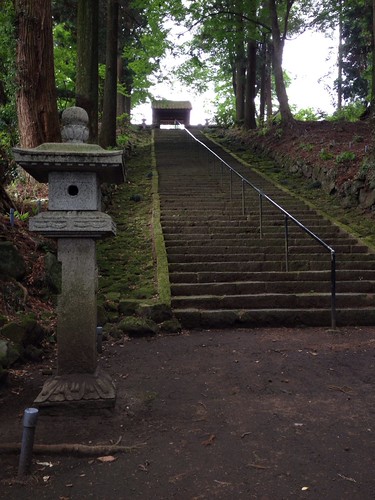
Stairs leading up to the Shrine in Aso
Road to the top of Mt. Aso
Horses Grazing in the Fields of Mount Aso
Mount Aso Crater
The sulphur crater of Mt. Naka-Dake in Aso

Mt. Naka-Dake or just Mt. Naka is the only remaining active crater in this area. The northerly wind, its’ speed and sulphur levels are high enough to warrant the closing of the highest viewing point. The sulfur from the volcano is pungent and sometimes overwhelming this morning causing some with sensitive noses to seek cover under protective scarves and surgical masks. The sulphuric gas can get to dangerous levels and warning signs are everywhere. We can either wait for the wind to change or just hike up a different direction. Today, the lower viewing point is still open, so we were able to get look at the open neon green crater and  hike up to the other side of the mountain. Some areas being off-limits because of the current wind conditions but there is more enough to see for first timers.

Why hasn’t Aso been on my list?

It’s easy to miss because Japan has always been a pricey destination for budget travelers. Most travel the country by using the JR rail pass which needs to be purchased before arriving to Japan. Until now, it’s has been the most popular and convenient way to travel to most towns and cities inside Japan. The JR pass is expensive since the price is in Japanese Yen and goes up and down as it’s value against the USD fluctuates. This is one factor that deters perspective tourists until recently.

Japan now has a couple of budget airlines that offer domestic flights from Tokyo many cities giving the JR Rail some much-needed competition. Peach Airline offers flights from many including departures from Osaka to a few cities in Kyushu and AirAsia will soon be offering flights inside Japan as well. Visitors now have more options and can now see more of Japan in less time including towns like Aso.

Mount Aso Crater
The lower viewing platform of Mt. Naka-Dake
Mount Aso Crater
Close look at the active crater of Mt. Naka-Dake
Mount Aso Crater
The No-Mans-Land area on top of Mount Aso
Mount Aso
Hike up above the crater of Mt. Naka-Dake in Aso

Must-See Museum just an hour away from Shanghai

Last month I had the great fortune to have the opportunity to have an extended visit to Shanghai.  Suzhou is one of the most popular day trip attractions for those visiting Shanghai. It’s even possible to visit when transiting through Shanghai because the high-speed trains go almost directly to Suzhou depending on the time. There soon will be a subway line that goes from the Main Train Station to the area where the museum is located.  For now,  there’s just the bus which requires some pre-trip planning to figure out which one and where or just the more expensive taxi.  It’s helps that the museum is free for both nationals and visitors.

Trip to the Suzhou Museum

Suzhou Museum inner courtyard
The center courtyard and rock garden with Koi Pond inside the Suzhou Museum

It’s hard to figure out what is more attractive at the Suzhou Museum – the featured items on display in the cases or the building itself. Chinese American Architect I.M. Pei is the chief designer of the Suzhou Museum. The museum displays Suzhou’s ancient and modern history, but some may find that the overall design of the building is the main attraction here.

Suzhou Museum
Modern Art on display inside the Suzhou Museum
Rock garden inside the Suzhou Museum
Wisteria Tea room inside the Suzhou Museum
Inside the Suzhou Museum
Display of Snuff Bottles inside the Suzhou Museum
Inside the Suzhou Museum
Detail of a carved Ivory Elephant Tusk inside the Suzhou Museum


Inside the Suzhou Museum
Snuff Bottle displayed inside the Suzhou Museum
Rock garden inside the Suzhou Museum