
Most Persian-style mosques are famed for their ornate surfaces and the interior of the Krezrety Omar mosque in Ashgabat certainly lives up to that rich history. What really catches the eye though is the unusual chandelier underneath the central dome. Oscillating, mesmerizing, and constantly reminding the faithful that the sumptuous surroundings are a mear diversion of focus to something much larger.
Foreclosure of a Dream

This unusually ornamented Lenin statue, one of the few still left standing in Central Asia, presides over the dismantling of his utopian vision. Perhaps it too will someday be glossed over in a sea of white marble, relegated to a brief moment of history.
Hidden in Plain Sight

It’s sometimes hard for the eyes not to focus on President Saparmurat Niyazov’s shining doppelgänger in Independence Park. Gold, however, eventually looses its luster (or in post-presidential times gets replaced) and we have to look closer for the timeless, more subtle, effects at play. Do you see them? How many Rub el Hizb can you count?
Back to the Beginning

Ostensibly this is the Monument to Ten Years of Independence from the Soviet Union, with a wild herd of ten Akhal-Teke (“Golden Horses”) coming over a ridge. These steeds, prized for their speed, endurance, and adaptability, have been bred for thousands of years by local tribes. Those tribes would trade them for arms, gold, and most prized of all a mysterious substance called ‘silk’ with merchants to the east. The genesis of the Silk Road.
The End of the Yellow Brick Road

The phrase ‘lost to the sands of time’ tends to conjure up thoughts of mighty empires that have faded away into the desert. Nisa, the first capital of the Parthians, is no different in the dusty hills a short distance outside of Ashgabat. The spectacular mountaintop setting on what is now the Turkmenistan/Iran border belies an eery silence of its literally lush past. Peaceful, yet one has to wonder if this is the fate of future realms as well.
It’s not easy being Green in Ashgabat

If a visitor just stayed in Ashgabat and never left the city limits then they would never think that it is literally an oasis in the middle of the water parched Karakum Desert. Fountains are bursting out clean water and offer some much-needed relief from the heat. The task of keeping the city and its surrounding parks both clean and green is a daily battle for the small army of city workers.

It doesn’t take more than a 5 minute drive from the city center to see the picture above. The Kopet Dang mountains in the south of the city mark where the vast Karakum Desert really begins. Here, there are no water fountains, air-conditioned bus stations or green parks. The newly planted evergreen saplings appear to be an effort to liven up the place, but it’s hard to think that they have any chance of a long life without water to feed them. It’s a hard life here in the desert even if you are in a country rich in resources.
President Gurbanguly Berdimuhamedow has a bold vision of doing the nearly impossible. He wants to transform the desert into a lush and green forest. His program is currently throwing money at the problem. This vision is a positive one that many would love to be brought to fruition, but it’s not too hard to see how this one ends.
A Moment of Silence

The near-empty streets of Ashgabat add to the eerie silence of the memorial to the 7.3 magnitude earthquake in 1948 that leveled the city and killed tens of thousands. Raising from the ashes of destruction on the back of a bull (traditional symbol of strength) comes a Golden Child (the future president, Saparmurat Niyazov).
A Visit to the Marble “City of Love”
What do you get when you combine Riad, Pyongyang and Las Vegas? Welcome to Ashgabat and the “City of Love”. The only thing french here are the architects who designed the palace Turkmenistan’s current leader President Gurbanguly Berdymukhammedov. Ashgabat or Ashgabat translated into Farsi literally means “City of Love”. This is what I have learned so far about this city before arriving. Our plane from Urumqi descended from the darkness of the Eastern suburbs into a valley of sparkling neon lights and glowing white towers. The colorfully lit city appeared lively from above, but we soon found out it was more like the typical 80’s sitcom plot where the well planned party that no one shows up to.
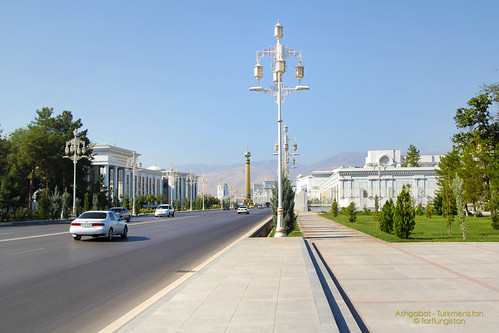
The customs and visa formalities went as quickly as they could after landing at the Saparmurat Turkmenbashi International Airport. We arrived in the early morning hours and our guide along with a driver were waiting in the empty arrival hall. We were anxious to get to our soviet style Hotel Ashgabat after the long flight. The guided tour is still a required for those wanting to visit for more than a few days and every minute is precious. The payment for this tour was due upon arrival in cold hard cash. It seems wise to pay with cast rather than making a pre-trip wire transfer.

We got our first glimpse of the city on our short trip from the airport to the Hotel Ashgabat. Our guide bid us farewell and said to just stop by the office in the morning. I had a laugh when his directions from the hotel to his office included “it’s the white building across from the shopping mall.” I was too exhausted to ask more. I just wondered if the city meet expectations the next day? Hopefully I’ll get to take some good pictures and maybe find that there is a way to get online here.
The Silk Roads of Turpan
The sites of all over China are slowly being torn down, added on to or just demolished into a more appealing and high ticket worthy site. The desert town of Turpan or Tulupan is no exception. Despite this, some sites in the area still attractive enough to justify an uncomfortable day of riding in a van over pot filled roads without air conditioning. Visitors also need to learn to look beyond the cluttered with junk stalls, dressed up camels and buzzing two-seater planes that obstructed the view and take it for what it is fast becoming which is a genuine tourist trap.
Here are a few sights worth seeing:
The Xianjiang Regional Museum


The Xiajiang Regional Museum here is most travelers first stop before heading out of the city. The free museum offers great overview of the history of the area. This is the best way to help visualize how the area could have once looked like, and make a plan of what to see before heading out. The museum also is a great way to take a break from the mid day heat in the summer months.

The Ancient City of Jiaohe

The Jiaohe Ancient City is mostly ruins but the scale of it and the surrounding landscape make it well worth the trek out. It was tour bus free the day we arrived. It was later in the day so the views were spectacular and the vendors were too tired by then to even bother with us.
The Flaming Mountains

The mountains are along the highway that leads to the Bezeklik Thousand Buddha Caves making it an easy stop along the way. The subterranean museum/gift shop isn’t really that interesting, but the mountains beyond the entrance, the paragliders and dressed up camels are a beautiful especially at the end of the day.
The Emir Minaret
The Minaret itself is worth a visit, but don’t worry if it’s too late the enter the mosque area. It closes around 4:30pm and in the summer the sun doesn’t even set here until around 10pm. The Mosque and Minerat is fenced in and it’s surrounded by fields of grape vines and an older muslem neighborhood. It’s a surprise to see that it remains untouched by the authorities. Many of the homes contain second stories which are essentially large windcatchers which help cool traditional desert homes during the hot summer months. It’s easy to get lost here so it’s good to carry a good map or a GPS device if you got it.


 Farflungistan