Princess of Two Worlds

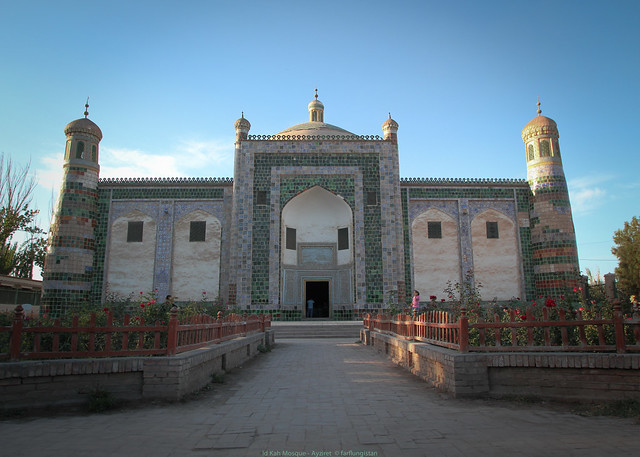
Afaq Khoja Mausoleum in Kashgar China

Afaq Khoja Mausoleum in Kashgar China
The Apak Khoja mausoleum is where five generations of the Apak Khoja family lay to rest. One of them is the subject of two very different folktales.   The Han cast her as a romantic Uyghur princess and she is  known as the “Fragrant Concubine” who is a loving companion of a Han Emperor who united a once divided nation.   In the Uyghur version, she is known as Iparhan, granddaughter of Apak Khola. Locals say she died in Beijing after being taken there by force by a victorious and greedy Han Emperor.  It is thought that she either committed suicide or a her jealous mother-in-law ordered a eunuch to murder her.  Iparhan is a nationalist hero of the Uyghur people who symbolizes the resistance against the Han.

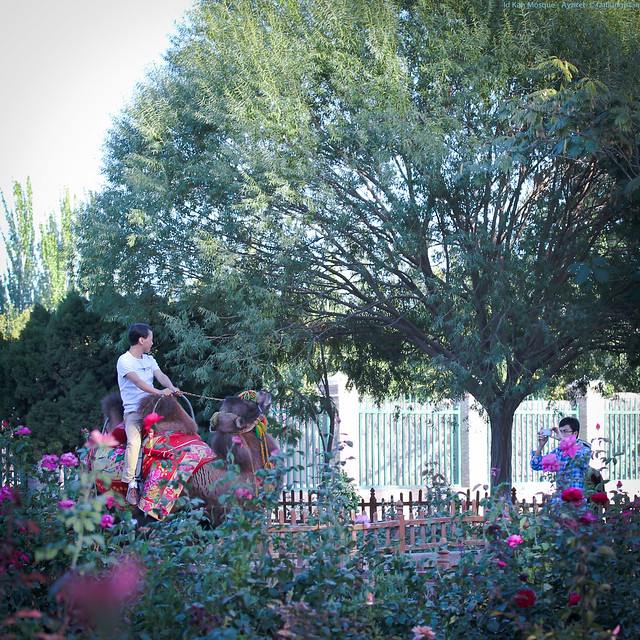
People from both camps come here to see where this mythical princess lays to rest.  The tomb is possible empty because both tales are pure fiction.  The government has decided to keep the dream of the “Fragrant Concubine” alive and charges visitors to see what used to be a Sufi pilgrimage site. It’s upkeep and renovations are not cheap.  Camel rides are not included.
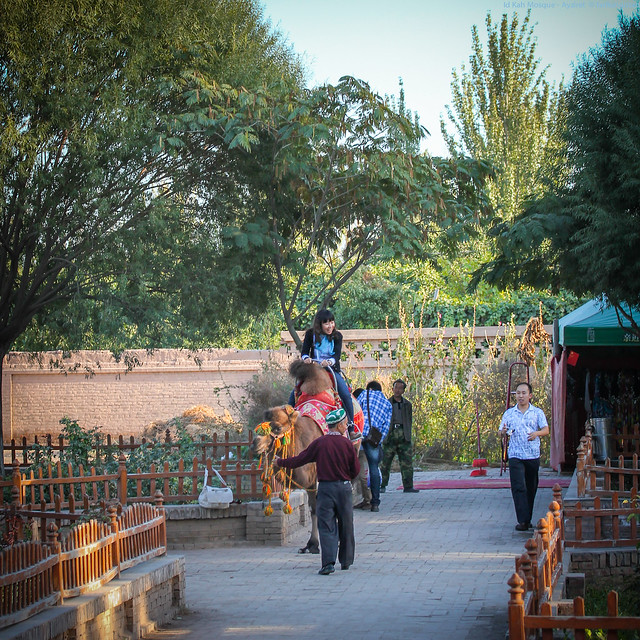
Afaq Khoja Mausoleum in Kashgar China

Afaq Khoja Mausoleum in Kashgar China

Getting Dusted

There’s only one road to get to the Afaq Khola Mausoleum after getting off bus no. 20 and it’s a dusty one. Walking would be pleasant if it wasn’t for the all the dust made by vehicles operated by senseless drivers. Getting a ride in a horse and buggy can be a good but budget busting alternative.

Pomegranate Tree of Life

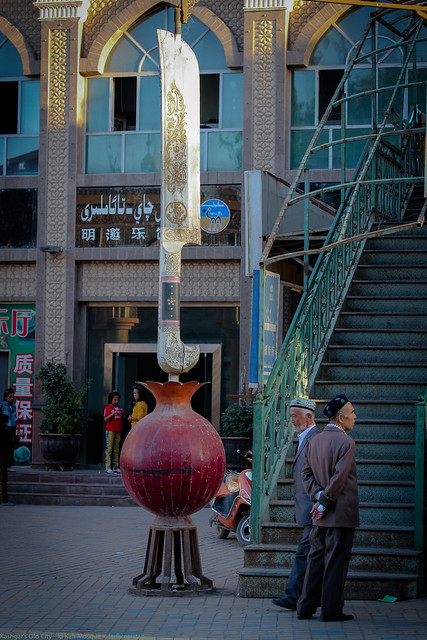
A large pomegranate fruit sits in the middle of Kashgar’s Old City just behind the refurbished Id Kah Mosque.   The Chinese have long believed that this fruit symbolizes fertility and those consuming it will have a long life and possibly chance at immortality.  In ancient Egypt, the fruit represented ambition and prosperity. The consumption of these fruity seeds by Persian warrior made him invincible.  The pomegranate will hopefully offer such gifts and more to the Uighurs here in Kashgar.

Shopping District behind the Id Kah Mosque in Kashgar

Time to head home

Goats waiting to leave the  Sunday Livestock Market in Kashgar

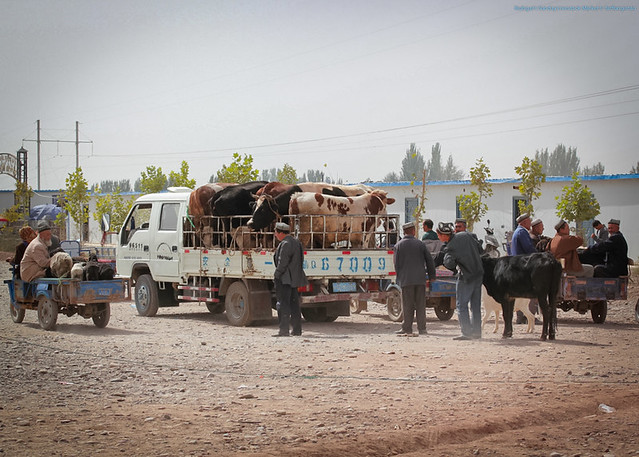
Animals usually travel to and from Kashgar’s Livestock Market on the backs of trucks, inside the trunks and back seats of cars, or packed inside trailers pulled either by a motor bike, horse or donkey.  Sheep and lamb are usually tossed in and out like bails of hay, while agitated cows, camels, horses and donkeys get pulled and lifted into and out of the backs of trucks.  Visitors will find it hard not to marvel at a group of men collectively pushing a few stressed out cows up and on to a truck bed by using all means necessary.  The best maneuver that afternoon was something that can only be described as the tail twister.  Check out this video by stefhoffer on YouTube for a better look.

End of the day at Kashgar's Livestock Market

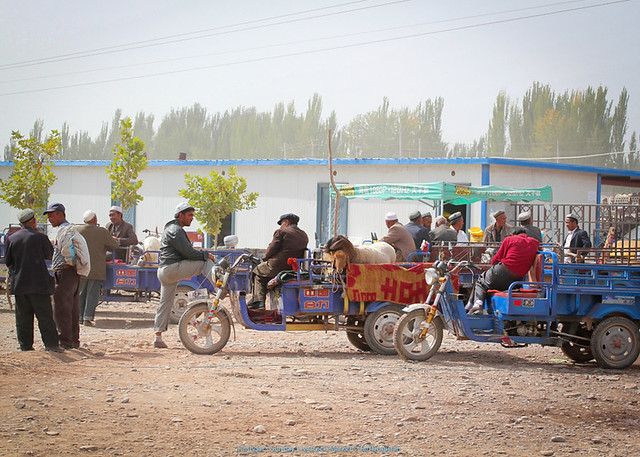
Socilizing at the Livestock Market Parking Lot

There is more than one way to dress a sheep

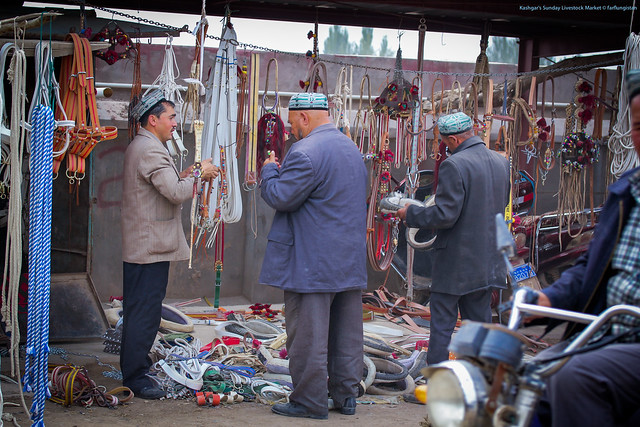
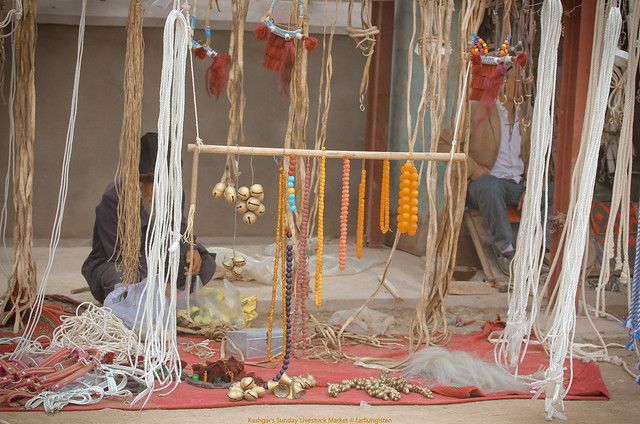
Horse halters and accessories inside the Sunday Livestock Market in Kashgar
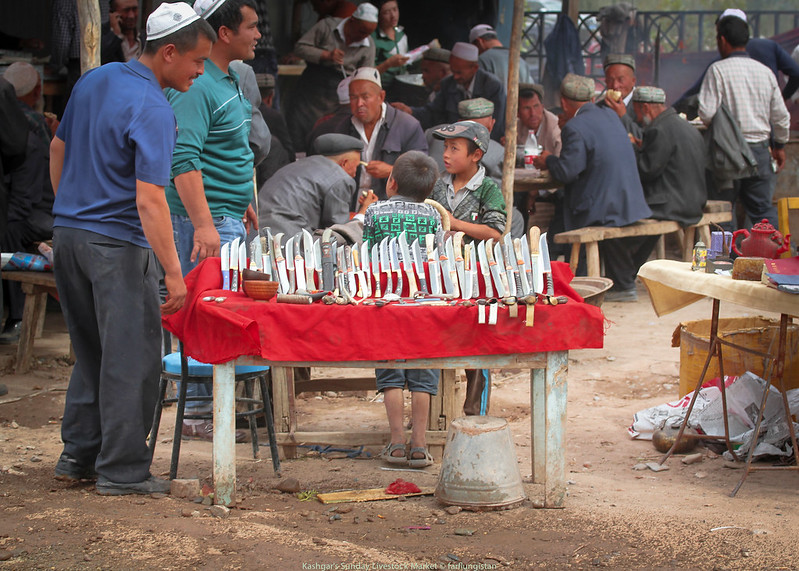
Scenes from Kashgar’s Sunday Livestock Market in China’s Xinjiang Province are more typical of neighboring Kyrgyzstan or Kazakhstan then of the Motherland itself.  How big your flock is, how well they cared for and their appearance is a reflection on the owner and his family.  A respectfully dressed sheep and a nice knife are a sign of wealth and taste here in Kashgar.

Handmade knives for sale  inside the Sunday Livestock Market in Kashgar

Horse halters and accessories inside the Sunday Livestock Market in Kashgar

Silk Road Market Canteen

Eating stalls inside the Sunday Livestock Market in Kashgar

Sunday Livestock Market remains unfazed by political skirmishes, religious clashes and regional social shifts. At this point, regional disruptions pass through town like dust storms through the Karakorum desert. Most deals and negotiations being made each Sunday, whether it be an addition to the flock or more horse power, usually involve the parties acting in a courteous and respectful fashion. The canteen is where these satisfied businessmen stop and enjoy kebab and chat after a long morning of wheeling and dealing.

Handmade knives for sale  inside the Sunday Livestock Market in Kashgar
Learning the ropes at Kashgar’s Sunday Livestock Market

Eating stalls  inside the Sunday Livestock Market in Kashgar
Eating the profits at Kashgar’s Sunday Livestock Market

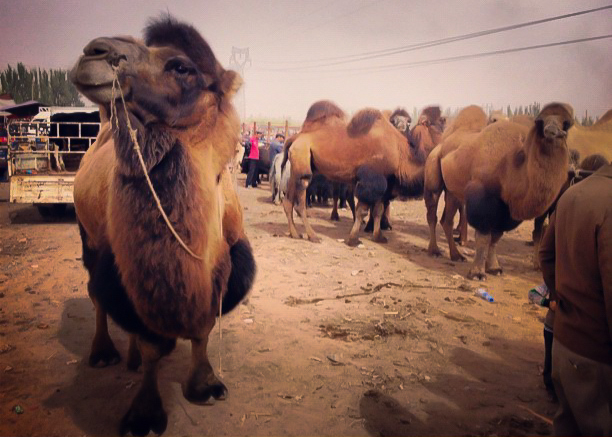
Waiting for a buyer

The Beauty and the Beast


There’s just one word to describe the Celestial Mountain region in Kyrgyzstan – heavenly. The sweeping valleys are full of playful yaks, wild horses and yurts set up at the foot of the hills.
Traders, spiritual nomads and adventurers trekked along these ancient Silk Road passages for centuries. Today, the dirt roads get more traffic, but their appearance on the western side is still stunning. The heavenly vision sadly vanishes at the gates of hell or what is known as no man’s land on the Chinese side of the Torugart Pass. It’s a bit startling to find a rather large group of young Chinese border guards, some feral dogs and a group of decaying buildings. Don’t expect a huge welcome wagon here.

Yaks in the Celestial Mountains - Kyrgyzstan

Missing the Point

The American University of Central Asia is housed next to a phantom shadow of the Lenin.  Its main building was once headquarters the Kyrgyz’s communist party and supreme council.  Eager students here study journalism, law and politics as the larger than life Lenin statue looks on with disapproval.

Smoke ’em if you got ’em


Soviet history hasn’t been tossed away here in Bishkek, but stands proudly on display in the National Historical Museum in the city center. The mural on the top floor pretty much sums up the whole Soviet mantra – from its celebrated beginnings to its bitter Cold War end.
The signage is mostly in Russian here, but most displays at the Lenin Museum are easy to comprehend.