The Good and Bad of Travel in Iran

Biggest Surprises and what surpassed my expectations in Iran

There’s only so much blog reading and picture browsing a future traveler can do before setting out on an adventure to a foreign land.  Information that’s out there via blogs, pictures news articles – reliable and current on travelling to Iran isn’t as prevalent as say Europe or South East Asia.  The official news publications are just full of endless stories that conger up fear and bloggers tend to be on the opposite side saying how hospitable the Persian people and  how beautiful the landscape and architecture is.  I sorted through it all and did the trip.  This is the basic likes and dislikes about what I personally witnessed while traveling a well beaten trail through central Iran.

Wonderful hospitality despite the constant bullying and bickering going on between other nations and theirs

It is said over and over again on various blogs, articles and travel shows that Persians are undoubtedly the most friendly and welcoming cultures of the world.  I also immediately comfortable when arriving 2 hours late after a 30+ hour journey from JFK to Shiraz International.  I’m an amateur hijab wearer who is both jet-lagged and  half conscience – where am I?  I’m alright but I’m concerned that my semiconscious self  is not going to notice if the scarf falls off my head.  At least it’s a very odd hour and not the middle of the day.   I, as a guest, am little nervous about offending anyone at this point.  At passport check we are the only ones in the “Foreigner Line”.  The officials get all the locals done and soon start to check out our credentials.  They apologized for not having the finger printing device working immediately.  No worries.  It only took a few minutes for what seemed like just a quick warm up and connection to the computer.  It was a short wait and I wasn’t moving too fast anyways.

Our start was much easier then the worst senario I had in my head before departing almost a day and a half ago.    I never had any close wardrobe malfunctions and very little culture shock. The people I met along the way were wonderful.  It was not all great but what trip is perfect?   Here’s some general thoughts – both good and bad to be balanced- about my experience in Iran.

Amazing Architecture anyone can enjoy without a PhD in Ancient Architectural Studies

Masjed-i Jamé mosque
Jame Mosque in downtown Yazd

This region is full of buildings, archeological sites, ancient texts, art and textiles which date back thousands of years in some cases.  It’s amazing what still remains to be seen today after countless wars and military conflicts have damaged and destroyed so much in this region over the centuries.  Many things have been taken or sold as some claim to museums in western Europe and North America.  It’s great to be able to see it in person like the permanent exhibit of Islamic Art that recently opened up at the Met  here in New York City, but there’s nothing like seeing it in person where it came from.

MET Museum Islamic Exhibit NYC

Much more is being uncovered by those working hard under skilled architects and hopefully more will be available for the public to see in the future despite current political conflicts.

IMG_4576
Inside the Bagh-e Dolat Abad in Yazd

Too much to see in too little time

Isn’t that always the case?   We were allowed 14 days since that was how long our required tour was going to last.  No tour – no guide – so no more days are needed on our visas.  Tours are not cheap so we’ll have to go back. The rumor mill says that once the first visa is granted then the next is easier to acquire, it’s faster and more days could be granted.

Lots of  bad music

Blame the US embargo for this one.  Our guide mostly played traditional persian music as well as Persian Pop music while we traveled along.  One day the subject of what kind of music we liked came up.  Of course, we are fans of Led Zeppelin, Silversun Pickups, Radiohead – just to name some better known acts that he might be familiar with – well Mahmoud just smiled and gave a few nods – he more than likely heard of them but not a fan.  He said he was a fan of Mariah Carey, Celine Dion,  and the Eagles  – all of whom sing about romantic new love and getting dumped – sound familiar?   Mahmoud was a big fan of the poet Hafiz like many Persians.   He also was being his hospitable self and decided to give us a break from Persian music – which I add was enjoying – and put sometime on that he thought we would like.  Not sure if it was Celine or the Eagles but the CD player was busted and the Persian music resumed.

Persians feeling they needed to apologize for their government

Na'in's Jame Mosque
Na’in’s Jame Mosque

Not many people are happy with what either side has been doing lately or the last 30 years for that matter.  I hope there is a time that the region will be at peace. Our countries governments and political powers that be must start looking forward.  The Persians still harbor resentment of the Muslim conquest of the Persian empire hundreds of years ago.  The decline and fall of the Sasanian Empire led to the rise of Islam in a region whose religion was dominantly Zoroastrian religion in Persia.  and just about eliminated their form of Islamic faith and Zoroastrianism.

Zoroastrian Cemetary
When the fire temples stopped being used Zoroastrians began being buried in cemeteries near by

The new generations want more freedom to do little things like sporting fashionable hairstyles and wearing clothes and jewelry that express their individual personalities.

Shiraz: Few more interior pics of the Arg of Karim Khan

Here’s more pictures of the interior of the Arg of Karim Khan. I asked what this hole was for and my guide just said “It’s just a hole” and strudged his shoulders. Doh…Sometimes you have to ask those dumb questions. It was probably just for air since it gets pretty steamy in this area of the world.

Arg of Karim Khan
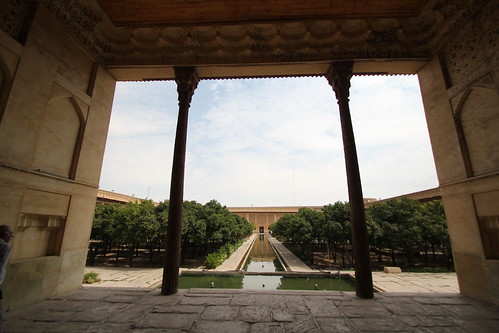
Classic Persian Garden with fruit trees and center pool
IMG_4044
Courtyard inside the Arg of Karim Khan
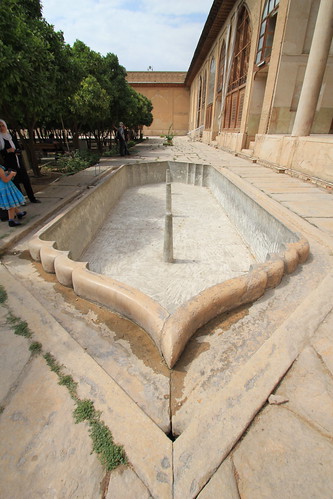
Courtyard of Arg of Karim Khan
Beautiful gardens of the Arg of Karim Khan
Arg of Karim Khan
Side room of the Arg of Karim Khan
Wooden Columns of Arg of Karim Khan
Water Fountain inside the Arg of Karim Khan
Arg of Karim Khan
Arg of Karim Khan
Bath Ceiling in Arg of Karim Khan
Ceiling of the bath that leads to the leaning tower
IMG_4064
Details of bath interior at the Arg Karim Khan

Good times…when the Zand Dynasty made Shiraz Persia’s Capital

The fortress known as Karim Khani Citadel today shows signs of age.  There’s a tilting tower, missing columns and a Qu’ran missing.  It’s almost 300 years old so all of this isn’t unexpected.  The structure was the main residential palace of Karim Khan-e-Zand and his dynasty and later in the mid 20th century home to prisoners beginning in 1936.  It closed in 1971 and is slowly getting much needed repairs after centuries of misuse and vandalism.

Arg of Karim Khan
Friendly locals we met outside the Arg…the statue looks like a Brit but not sure who it represents

The Citadel was looks like a medieval castle complete with a dry mount surrounding the tall thick outer walls.  The outside is simple but the inside contains traditional Persian gardens and rooms enclosed with colorful red, blue, yellow and green pained windows. Karim Khan-e-Zand made Persia’s capital Shiraz and built this complex for himself and his militia in 1766-7 AD. The humble leader decided to loose the title of king and decided to be known as a regent or Vakil in Farsi.  He hired the best designers and builders to make his fortress and they used the highest quality materials.

Arg of Karim Khan
Simple exterior walls of the Arg Karim Khan..easy to see additions made in both high and design
Arg of Karim Khan
The leaning tower of Arg of Karim Khan up close
Arg of Karim Khan
Large tile image of the killing of the white devil by Rustam made during Qajar dynasty

When the Qajars gained power over the weaken Zand dynasty the capital and most of it’s Notice the columns made of wood that support one end of the inside pavilion. The originals were made of marble and were stolen. They were at least replaced with the simple wooden ones that remain here today.

The elephant in the room of this castle is the noticeable leaning in the tower at the far southeastern corner. The Khan constructed an underground septic system and his bathhouse resided inside this 14 meters tall tower.

Bath inside the Arg of Karim Khan
Bath inside the leaning tower of the Arg of Karim Khan

The water table has lowered substantially over the decades and hopefully something will be done about the obvious separation of it and the supporting walls attached to it.  It will probably just take a minor earthquake to release the tower from the rest of the fortress.  Let’s hope this doesn’t happen before it’s given a proper patch job.  Right now, it looks as if someone just took a bit of gum and filled in the open wedge.

Arg of Karim Khan
Southwestern observation tower which contains bath house responsable for the lean

Inside the Arg of Karim Khan is simple because much of its treasures were stolen or removed after the Zand Dynasty was conquered by the Qajar. The marble pillars were removed by the Qajar conquers and brought to Tehran where they made the new capital of Persia.

Wooden Columns of Arg of Karim Khan
Wooden Columns left behind by the Qajars after the Zand Dynasty was sacked

The floor of the inner courtyard is made of large stones brought in from the surrounding mountains of Shiraz. The workers were paid for the amount of stone they laid down. The way that they kept track of which stones the individual brought in was by a symbol that was carved into the top of the stone. These can still be seen today if you look at the stones on the near right corner of the main entrance.  This information can’t be confirmed online and is something our guide pointed out to us when we entered the courtyard.  I was too much in awe of the interior that I forgot to get a picture of it. I guess you’ll have to see for yourselves.

Tons of pictures of Shiraz: Another visit to the Valik Mosque

Late day light and visit to the Vakil Mosque

It was the third day into my trip to Iran and my husband and I were ready to take out on our own.  The jet lag had finally faded and the streets of Shiraz were becoming more familiar.  We were on a “tour”  but it was getting a little stifling and we needed to get some air so to speak.  The visit to the Valik Mosque the previous day made a big impression on us and we wanted to go and see it again.  This time, it wouldn’t be in the middle of the day and without someone patiently waiting for us to move on to the next site on the day’s itinerary.

The Valik Mosque is very colorful and the tile work of its walls is full of flowers, birds and geometric patterns characteristic to the city of Shiraz.  When I think back to my visit to Shiraz it’s the one site I felt summed up the beautiful city.  It’s best to visit late in the afternoon and sometimes this may coincide with evening prayer.  It’s not a working mosque, as mentioned before, but many locals still visit for prayer.  The small admission visitors from out-of-town pay goes toward the continuous maintenance of the grounds so don’t feel like you are intruding but be aware of late day worshippers when you are looking around in awe and taking a million pictures.  This is when it gets tricky keeping the hijab from slipping off my head and getting pictures of the tall walls at the same time.
Vakil Mosque

Vakil Mosque

Vakil Mosque
Vakil Mosque
Tree of Life at the Vakil Mosque - Shiraz
The Tree of Life
Vakil Mosque
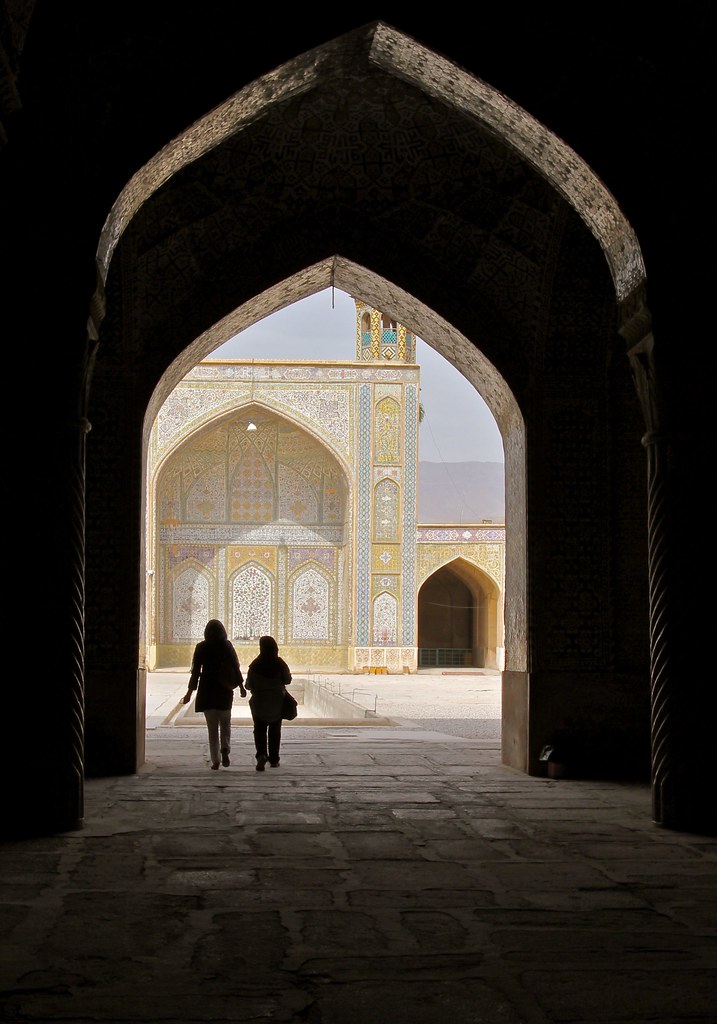
Courtyard of the Valik Mosque

Vakil Mosque

Vakil Mosque
Ceiling inside the Valik Mosque
Vakil Mosque
Looking North inside the Valik Mosque

Pictures of Shiraz: First visit to the Vakil Mosque

The first visit to the Valik Mosque located or attached to the Valik Bazaar. The mosque, built between 1751 and 1773, is the best example of architecture constructed during the Zand Dynasty when Shiraz was the capital of Persia. It has withstood many earthquakes and invasions. The mosque is now a registered historical site and is no longer a working mosque. Many worshipers still come and pray here despite this and who can blame them. It’s one of the most beautiful and peaceful places in Shiraz and it shouldn’t be missed when visiting.

Vakil Mosque
Entryways of the night prayer room at the Vakil Mosque in Shiraz
Vakil Mosque
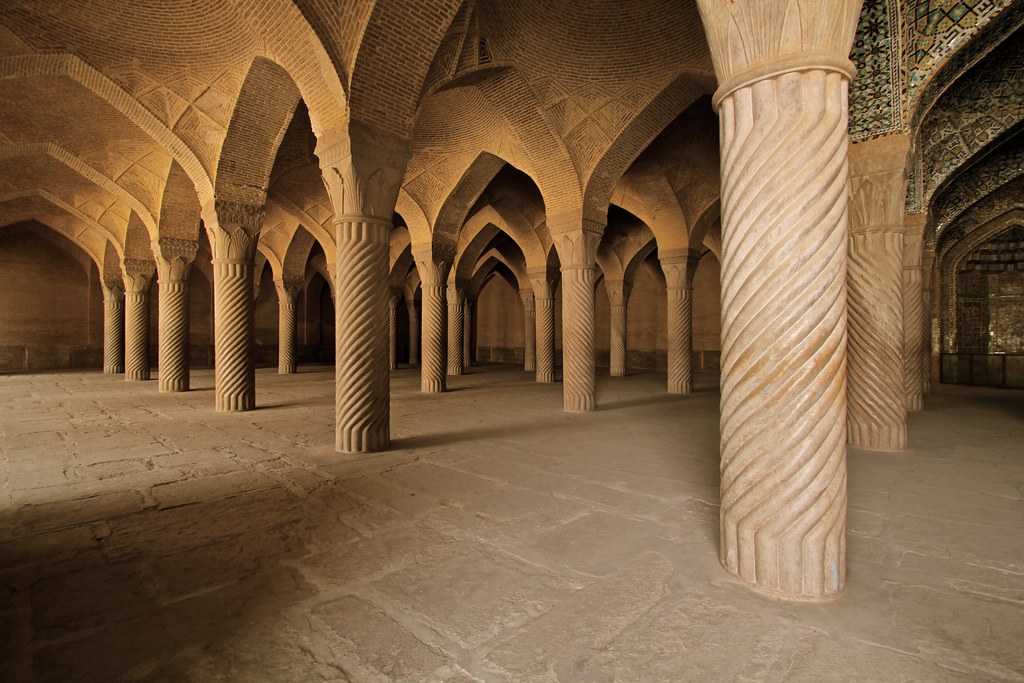
Main Prayer hall inside the Vakil Mosque. Its night prayer hall (Shabestan), with an area of approximately 2,700 square meters, contains 48 monolithic pillars carved in spirals, each with a capital of acanthus leaves.
Vakil Mosque Colorful Ceiling Tiles of one of it's Iwan's
Bees Nest or ceiling of the pishtaq of Valik Mosque
Vakil Mosque
Shabestan ceiling
IMG_20110911_065931
Pishtaq (decorated entrance) of the Valik Mosque
IMG_20110911_065720
Minbar that is made of a single piece of solid green marble at the Valik Mosque

Iran: What’s on Tap?

After a long hot day on the Silk Road trail travelers like myself are looking for a comfortable seat, good company and a cold beverage to go along with it all. The there’s plenty of beer to choose from at the local packy. They usually come in flavors like pomegranate, lemon, lime, mango, peach and of course original Malt.  Most get it right by being deep yellow in color and get that light foam action when poured into a glass.  The most important thing is missing – alcohol.  There’s 0% in each can or bottle.  The only thing a consumer feels if they toss back a six-pack is a sugar buzz and a stomach ache and a hang over the next day.  I don’t even think that they contain any caffeine?  I guess you would need to chase it with a strong cup of tea and a hit off the Shesha pipe to feel any mental adjustment. I was kind of hoping to find something like Kvass – a beverage made from fermented yeast and grains.   Children in Russia drink it like soda even if it is anywhere from 1-2% alcohol level.  Still too little strong for the locals in Iran and other Muslim societies.

Here’s a list of some of my favorites:

Delster Malt Beverage:

This was the first one I tried and couldn’t finish it.  It’s a locally “brewed” non alcoholic beer.  I wonder what “Cooper” flavor tastes like?

Persian Beer in Yazd
Iran’s own.  Has a light lemony taste and very fizzy..not bad if one can find a cold one.

Istak Malt Beverage:

Gotta love their tag line – Go ahead “Drink & Drive” This one is imported from Malaysia where they love sweet beverages.

IMG_20110914_063659
Least favorite Malt beverage but good if you are looking for a natural tasting Peach or Mango soda

Hey Day from the makers of Zam Zam Cola:

Hey Day Malt flavored is the closest to the real thing minus the buzz of course. It’s got the color, the fizz level and not so sweet taste. It’s made in Mashhad and the parent company Zam Zam is very fashionable in Malaysia. Coke and Pepsi were banned in Iran for a period of time and Iran’s Zam Zam Co. stole developed their own version of the cool refreshing drink.

IMG_20110915_042954
The best near beer drinking experience…at least it looks like the real thing

Rumors around the hostel common areas say that one can get some sort of clear alcoholic swill if anyone is up for the adventure.  It requires talking to many local taxi drivers, some cash and luck.  Luck on many sides.  First is not getting caught by authorities, next is not getting robbed and lastly, not getting alcohol poisoning since most don’t know what they are getting.  Much of the alcohol isn’t from duty-free in Dubai but home-brewed and possibly moonshine or gasoline?

I was happy with my choices of water, tea, malt beverage or Doogh – a yogurt drink similar to Ayran in Turkey.  Add a little mint…some salt and I’m set. I stuck with the acceptable drinks which will most likely not give a hangover or send me to the nearest hospital or worse.

IMG_19800106_010253
My usual…good for the stomach after a big meal of kebab and rice

Ancient Persian Propaganda at Bishapur

The Shapur City or Bishapur is a city built by a defeated Roman Army and their Emperor Valerian. Shapur had many reliefs carved depicting his greatest victories in the battlefield and can still be seen along the sides of the Tang-e Chowgan gorge and under the graves entrances at Naqsh-e Rustam. Shapur is easy to spot since he is the largest and grandest figure in the scenes. The defeated are usually found decapitated with what remains lying under the hooves of horses and the living bowing down to the Persian mounted victors.  Unfortunately, an aqueduct built along the gorge in the 1960’s and later removed in the later 1970’s made a distinct mark along the reliefs seen below.

Reliefs along the water in Bishapur and in the hillside at Naqsh-e Rostam have managed to stay well-preserved considering this was an area where many battles were fought, earthquakes frequent the area and citizens have put there immediate needs before maintainance and preservation of its ancient past.

Reliefs at Tang-e Chowgan gorge showing victories of Shapur I over Roman troops
Bishapur: Relief (similar to older relief of Ardasir I at Naqsh-e Rostam below) depicting King Bahram I and supreme god Ahura Mazda
Reliefs at Tang-e Chowgan gorge showing victories of Shapur I over Roman troops
Reliefs near Bishapur along the Tang-e Chowgan gorge showing victories of Shapur I over Roman troops
Reliefs at Tang-e Chowgan gorge showing victories of Shapur I over Roman troops
Enemies of Shapur I pay tribute to the King

Down the street at Naqsh-e Rustam…

Naqsh-e Rostam
The oldest relief (left) of Naqsh-e Rostam of Ardašir I and (right) first relief of Bahram II
Naqsh-e Rostam
Investiture Relief of the Sasanian king Ardašir I (224-241) is the oldest Sasanian monument at Naqš-i Rustam on the left
Naqsh-e Rostam
Bahram II with his relatives Bahram I, Shapur I, and Ardašir, the founder of the dynasty standing to his left but right of Ardasir’s relief
Naqsh-e Rostam
Rock-face relief at Naqsh-e Rustam of Shapur (on horseback) with Philip the Arab made Emperor of Rome and defeated Emperor Valerian.

Shapir I and his army defeated the Romans in the battle of Edessa – seen here in animated form.  The romans captured Emperor Valerian  and took the remaining warriors back to build the city of Shapur. Valerian spent the rest of his life being constantly humiliated and tortured here. Legend even states he was used as a stepping stool by Shapur when he needed to mount his horse.

Naqsh-e Rostam:  Shapur (on horseback) with Philip the Arab and Emperor Valerian
Shapur, newly appointed Roman Emperor Philip the Arab and defeated Valerian along with relief of equestrian battle between Bahram II and Roman Ruler Carus

Naqsh-e Rostam: Achaemenid Empire and Murderous Sibling Rivalry

Valley of the tombs of four great kings of the Sassanid period

Naqsh-e Rostam doesn’t look like more than a few holes in the side of a hill of limestone.  This hill is where four great leaders of Persia once laid to rest – Darius the Great, Xerxes I,  Artaxerxes I and Darius II.  These men lived at a time where brother killed brother in order to gain the power they thought they rightfully deserved.  It was survival of the strongest or the greediest perhaps. Murdering to gain position became a common practice in the Achaemenid household.

These cross-shaped tombs look as if they were constructed at the same time since they are all built to almost the same specifications.  The first Darius the Great – said to be completed around 493 BC and the last was built for Darius II – great-great-grandson to Cyrus the Great – around 400 B.C. when he passed.  So, these were all built in a span of  90 years – give or take a few years.

Naqsh-e Rostam
Center stairway entrance to Naqsh-e Rostam
Naqsh-e Rostam
Young guard dogs of the Nashq-e Rostam
Naqsh-e Rostam
Cross shaped tombs of Darius the Great
IMG_4264
Tomb of Darius the Great. Umbrella is needed to view in the hot months

Tomb of Darius the Great (son-in-law of Cyrus the Great 522-486 BC)

A few scrappy puppies stand guard at the tombs of Naqsh-e Rustam.  They couldn’t be bothered on this hot September day in southern Iran. This impressive but little visited site is a 20 minute drive from its more popular stepbrother Persepolis.  Darius the Great – son-in-law of Cyrus the Great was the first occupant of this Necropolis. The cliff side cemetery was his idea. His tomb’s was built during his reign and  was completed seven years before his death in 486 BC.  He had many wives but the most important one was Astossa who is the daughter of Cyrus the Great and mother of Xerxes I was king after Darius.  Darius became king after Cyrus’ son Cambyses II died of a leg wound that was either self-inflicted or happened during battle.  Bardiya, younger brother to Cambyses II, succeeded him but later murdered by a group of seven nobles who then made Darius their king.  Darius the Great was best known for completing many of the construction projects started by his father in law Cyrus the Great.

Naqsh-e Rostam: Tomb of Xerxes I of Persia

Tomb of Xerxes I (son of Darius the Great 486-465 BC)

Darius’ son and successor, Xerxes I, grave is found next to his father’s. Xerxes I wasn’t Darius’ eldest son,  but the only one “born in the Purple” or of royal blood. Xerxes fought many battles and is best known for building the largest structures at Persepolis, the Gate of all Nations and the Hall of a Hundred Columns.  He also completed the Apadana, the Palace of Darius and the Treasury all started by Darius.   He added on his own palace which was twice the size of his father’s. Xerxes I and is young son Darius were both murdered by his royal guard Artabanus the Hyrcanian.

Naqsh-e Rostam
Tomb of Darius II

Tomb of Artaxerxes I (son of Xerxes I 465-424 BC)

Artaxerxes I came into power after the assassinations of his father Xerxes I and his young brother Darius.  Artaxerxes I lived until he was 54 and all that is known about his death is that it happened sometime in between December 424 B.C. and March 423 BC.  He is known as Artaxerxes Longimanus.   He had the nickname  Longimanus because his right hand was longer than his left. He fought battles against the Greeks. He continued to support the rebuilding of the Jewish community in Jerusalem which had begun under Cyrus the Great.  He died by natural causes unlike most of the rulers of the Achaemenid Period.

Tomb of Darius II (son of Artaxerxes 423-404 BC)

Vahuka, letter becoming Darius II when king, came to power after the death of two of his elder brothers.  Xerxes II was the only one “born in the purple”. He was the crown prince and son of the Queen.  His other two half brothers, Vahuka – later known as Darius II – and Sogdianus were born out of the royal line.  Xerxes II was next in line and was given the throne.  His brother Sogdianus murdered him 45 days later.  Sogdianus lasted only six months until he was also murdered by the commander of the cavalry who didn’t recognize his rule.  Historians can’t agree about what really happened.  It doesn’t help that Sogdianus married his half-sister and both murdered sons Xerxes II and Sogdianus declared themselves king before their father’s body was cold.

In the end, the next brother, Vahuka or Darius of Ochus became king. He was the son of Artaxerxes and a Babylonian concubine, hence the nickname of Nothos which means the child of unmarried parents.  He had a lot of help from his wife and half-sister.  He is said to have taken care of things and got rid of the rest of his relatives in secure his seat.  Artaxerxes I had 18 children.  There are very few details of Darius II life.  He fought  and survived many battles and held on to power much longer than Xerxes II and Sogdianus.  Unlike the two,  he does have a place at Naqsr-e Rustam and one must assume he was a great leader.

Naqsh-e Rostam:  Ka'ba-ye Zartosht
Naqsh-e Rostam: Ka’ba-ye Zartosht

Ka’ba-ye Zartosht

Is it a Zorastrian fire temple?  Not a fire temple but an ancient flood light that eliminated the tombs at night?  A royal tomb that was never occupied?   What this building was except an uncanny Doppelganger to one found at Cyrus the Great’s Tomb at Pasargadae.  Whether it was a depository for objects of dynastic or religious importance or tomb is a mystery that may be solved someday.  Much of the area of the site still remains buried and there are many objects, carvings and perhaps larger segment waiting to be discovered.  I’m looking forward to returning back – especially when it’s not over 100 degrees F.

side note: The sources I used to get information in this post was found from various places ranging from my guide Mahmoud to online sources to old-fashioned textbooks in the library. I have found the history about Naqshr-e Rustam or Naqshr-e Rostam has many versions. Please let me know if I have made any mistakes with the facts I have gathered.  Many of the facts are ones consolidated by larger accounts found in Wikipedia.

Pasargadae: How Alexander the Great and UNESCO saved it

Tomb of Cyrus the Great copy
Road to Cyrus the Great
Tomb of Cyrus the Great
Passer-by, I am Cyrus, who gave the Persians an empire, and was king of Asia.Grudge me not therefore this monument.

Pasargadae looks pretty barren today and its simple remains says nothing of how great of a leader Cyprus was to Persia.  The limestone tomb contained a golden coffin which rested on top of a table also made of gold.   Tall trees, flower beds, pools and waterways encircled the resting place of Cyprus the Great.  It’s called the “Four Garden”  style today is still the prototype for Western Asian architecture and design

When Alexander the Great arrived in 334 BC, the tomb had been destroyed by those who wanted it’s treasures.  Cyrus bones were scattered around outside of the tomb and thieves carried away treasures found inside.  Alexander was outraged and ordered the thieves to be prosecuted and had the tomb restored.

More is still be discovered today at the site.   Iran had announced that it intended to make the a dam near the site.  The dam could have caused the area to flood and the dampness created by the water would accelerate the deterioration of the fragile limestone.  The UN encouraged Iran to allow a team of architects from around the world excavate what they could before the dam became fully operational.  They  scrabbled for a bit in 2004 and uncovered many sites including a road that linked Pasargadae and Persepolis and caves believed to be inhabited 7000 years ago.   The site became a UNESCO site in 2004 and things are looking pretty good for this site and many others waiting to be discovered in the area.

The Audience Hall of the Pasargadae Palace
The Audience Hall of the Pasargadae Palace and the Zagroes Mountains
The Audience Hall of the Pasargadae Palace
The Citadel to the right and the Prison of Soloman to the Left
Prison of Solomon
Prison of Solomon