Bright Star

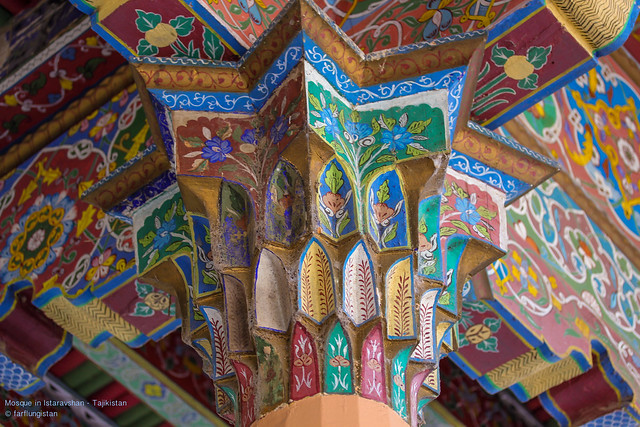
Some of the world’s most notorious leaders have passed through its gates – Timur, Alexander the Great and Genghis Khan to name a few.  Istravshan or Ura-Tyube controlled the Silk Road trade in its early days, and attracted a large number of skilled merchants and craftsmen who built and rebuilt many beautiful mosque, madrassas, temples and homes throughout the centuries.  Today, the city is a quiet museum that showcases over 2,500 years of the region’s history.   Visitors usually need to find the man with the key to see inside places like this one here.  It’s always good to add a donation if there’s a box at the entrance.

Colorful Past

Stalin and Lenin in Khojand's Market Bazaar

The giant Lenin statue is gone and the crumbling, dimly lit Hotel Leninabad has embraced capitalism.  They open after dark – serving drinks and beats to locals until dawn.

The most attractive vision of the past is this colorful pediment containing both Stalin and Lenin on the side of Khujand’s Panjshande Bazaar. This facade is probably seen as too beautiful to destroy.

Time is Relative

Russian Signage in a Tajik Mosque in Istaravshan

This ancient city is the one of the oldest Silk Road stops in the region whose history spans across 2,5oo years.  Istaravstan is one of those places where travelers can just spend the day getting lost in this living museum.  It’s also hard not to notice the more recent Soviet presence in the city after passing a statue of Lenin or signs written out in cyrillic.

Old habits die hard in Leninabad

Panjshanbe Bazaar
The Panjshanbe Bazaar is more of a reflection of Leninabad times than of the Silk Road Era long before it.  There is an overwhelming selection of dried fruits, nuts, candies in the main building.  It’s the first stop for anyone looking for electronics, socks, cosmetics or just a bag of kurut or dried yogurt balls.

Birds in Flight

Birds in Flight

Across from the Panjshanbe Bazaar lies the Mausoleum of Sheikh Muslihiddi who was known to be a holy miracle worker in ancient times.   Mongol invaders destroyed the city as well as the mausoleum in the early 13th century.   The mosque and madrassah are slowly being reconstructed now that the Soviets are gone as well.

As worshipers complete their afternoon prayers in the courtyard, a mother entertains her child by feeding the birds.

Stuck in time

Life standing still
Russia rolled into this region in the late 1800’s, embraced it with Soviet style reforms and began calling it Leninabad in 1939. Much of the city’s Soviet period architecture is a fading reminder of the last economic boom this city experienced.

Panjshanbe or “Thursday” Bazaar is where one can get a pair of socks, a loaf of fresh Naan, a boot leg music CD or a 20 kilo bag of potatoes. It’s current Soviet decor reflects on how the city remains to be stuck in time. The faux-vaulting wallpaper lining the entrance’s vaulted ceiling is fading and pealing, and the featureless statues greeting patrons have had 20 too many coats of silver spray paint.

Duality

The Double-Domed or Double-Cupola Mausoleum in Ancient Samarkand
Timur’s scholarly grandson, Ulugh Beg, was more interested in the stars above then following in his grandfathers footsteps in the battlefields below. His life’s ambition was to make his city of Samarkand the center of Islamic education and did this by inviting many other scholars to teach, study and conduct research inside the Registan.

Kazu-Zade Rumi, a Turkish mathematician and astronomer, was one of the most famous.  He researched and calculated the stars alongside Ulugh Beg, and helped develop a more accurate catalogue of the stars above them. He now lays to under two Cupolas and the stars here in Samarkand.

Diary of a Madman

Timur

History, largely written by conquerors, depends on what side of it you’re on. How are you remembered Timur? A military genius who was fluent in Persian, Mongolian, and Turkic? A blood thirsty butcher responsible for the death of 5% (at the time) of the world’s population? Or fondly as pictured here in Shakhrisabz as ‘Amir’ for your commissioning of many architectural wonders and patron to the arts? If one could only peak into your diary and wonder how you saw the world.